PIXER Single-Use Diaphragm Pump Hero Section
Engineered by Alphinity Logo

PIXER Single-Use
Bioprocessing Pump

Positive-Displacement Diaphragm Pump for Shear-Sensitive Cell Culture & Biomanufacturing

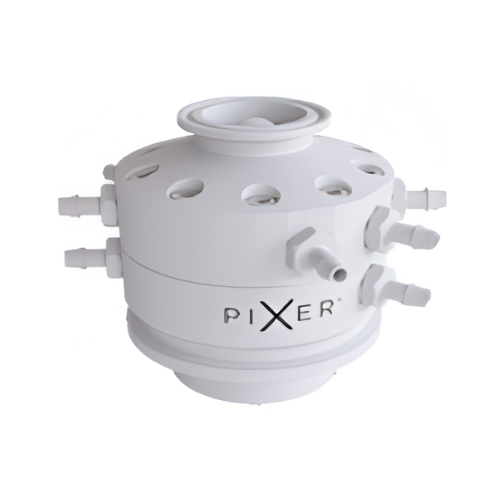
The PIXER single-use bioprocessing pump delivers predictable, repeatable flow with zero shear stress for pharmaceutical and biopharmaceutical applications. Engineered as a positive-displacement diaphragm pump, PIXER protects shear-sensitive cell cultures, monoclonal antibodies, and biologics throughout upstream and downstream bioprocessing—from seed train expansion to final fill operations. Seamlessly scale from R&D pilot batches to full commercial production with the identical pump architecture across five models (1 mL/min to 200+ L/min), ensuring process consistency and regulatory compliance from laboratory development through GMP manufacturing.

Zero Shear Stress
GMP Compliant
Minimal Pulsation
Easy Integration
Request Quote
PIXER Internal Cross-Section
PIXER Single-Use Diaphragm Pump
PIXER Flow Configuration
🏭
Industry Leader Pharma & Biotech
Compliance FDA & GMP Certified
📊
Flow Range 1 mL/min – 200+ L/min
🌍
Available Worldwide
PIXER Performance Comparison

Performance vs Traditional Diaphragm Pumps

Quantified advantages in speed, throughput, and biocompatibility

Speed to Target Flow
44% Lower

Reaches target flow at 44% lower motor RPM vs 4-diaphragm competitors

Output Under Pressure
67% Higher

Delivers 67% greater volumetric throughput at maximum operating pressure (4 bar)

Product Quality
Protected

Zero pump-induced degradation - maintains titer, infectivity, and particle integrity

PIXER Architecture - How It Works

The PIXER® Difference

Four engineering principles that deliver superior performance in bioprocessing

01

Positive-Displacement Architecture

Fixed volumetric output per revolution — predictable flow independent of downstream pressure.

0.73 mL to 185 mL displacement per revolution
Linear motor speed to flow relationship
Maintains precision across 0-4 bar pressure
02

Vertical Top-Inlet Design

Gravity-assisted suction eliminates cavitation and trapped air. Direct coupling to tank outlets.

Instant priming — no manual purging required
Prevents air entrapment at inlet
Full drainability maximizes product recovery
03

Five-Diaphragm Radial Configuration

Polymorphic Pump Technology® delivers smoother flow than traditional 4-diaphragm designs.

Significantly lower pressure pulsation
50% smaller footprint than linear configurations
Ultra-low hold-up: 22 mL to 2150 mL
04

Zero Shear Stress Fluid Path

Complete physical barrier between drive mechanism and process media. No moving parts contact fluid.

No mechanical shear from impellers or rotors
Protects mAbs, viral vectors, mRNA-LNPs, cells
Eliminates heat from friction or turbulence
PIXER Technical Specifications

Complete Model Range Technical Specifications

Comprehensive specifications across all PIXER® models from R&D to commercial manufacturing scale

Parameter P0 P10 P20 P30 P40
Tubing ID 1/8" - 3/16" 1/4" - 3/8" 3/4" - 1" 1" - 2"
Flow Rate
0.45 L/min @ 600 RPM Nom 1.1 L/min @ 1500 RPM Max
2.9 L/min @ 1750 RPM Nom 8.7 L/min @ 3000 RPM Max
29 L/min @ 1750 RPM Nom 40 L/min @ 2400 RPM Max
81 L/min @ 600 RPM Nom 135 L/min @ 1000 RPM Max
120 L/min @ 600 RPM Nom 200 L/min @ 1000 RPM Max
Displacement/Rev 0.73 mL 1.7 mL 16.7 mL 135 mL 185 mL
Operating Pressure 4 bar (60 psi) maximum across all models
Main Inlet Size 1.5" TC 1.5" TC 3" TC 4" TC 6" TC
Outlet Connections ⅛" HB ¼" TC or HB ¾"-1" TC or HB 1.5" TC 1.5" TC
Injection Ports ¼" TC or HB ¼" TC or HB ¼" TC or HB ¾"-1" TC or HB ¾"-1" TC or HB
Max Outlets 3 5 5 5 7
Max Injection Ports 3 10 10 5 7
Weight 0.3 kg (<1 lb) 0.44 kg (<1 lb) 2 kg (<5 lbs) 8 kg (<20 lbs) 12.8 kg (<30 lbs)
Materials PP body discs | Novelast® TPV diaphragms/check valves | EPDM O-rings
Compliance FDA Compliant | USP Class VI | ISO Class 7 cleanroom manufacture | BSE/TSE free
← Scroll horizontally to view all models →
PIXER FAQ

Technical Questions About PIXER®

Engineering answers about PIXER's architecture and performance advantages

Why does PIXER® use five diaphragms instead of four?
+

PIXER's five-diaphragm Polymorphic configuration phases displacement cycles at 72° intervals versus 90° for traditional quaternary pumps. This tighter phasing creates significantly smoother flow with lower pressure pulsation.

Performance impact: Reduced pulsation protects TFF membranes from fatigue, improves process control stability, and minimizes mechanical stress on sensitive biologics. The radial arrangement also delivers 50% smaller footprint compared to linear quaternary configurations while maintaining equivalent flow rates.

What's the advantage of PIXER's vertical top-inlet orientation?
+

The vertical design with gravity-flooded top inlet eliminates three common failure modes: cavitation at the inlet, air entrapment during priming, and incomplete draining after processing.

Instant priming without manual purging. Air naturally rises and exits through the outlet. The bottom-positioned outlet enables complete product recovery—critical when processing high-value biologics where even 100mL of trapped material represents significant loss.

How does PIXER reach target flow at 44% lower RPM?
+

PIXER's optimized displacement geometry per diaphragm generates greater volumetric output per revolution. The five-diaphragm radial configuration delivers equivalent flow rates to quaternary competitors while running at dramatically lower motor speeds.

Lower RPM means less mechanical wear, reduced vibration, and extended service life. It also reduces heat generation and power consumption—particularly relevant for continuous bioprocessing operations running 24/7.

Why does PIXER deliver 67% higher flow at maximum operating pressure?
+

Traditional diaphragm pumps experience significant flow degradation under backpressure due to check valve inefficiency and diaphragm deflection limitations. PIXER's engineered check valve geometry and optimized diaphragm mechanics maintain volumetric displacement even at 4 bar.

Real-world impact: When driving TFF systems, depth filters, or chromatography columns that create substantial backpressure, PIXER maintains target flow rates without requiring oversized pump models or frequent speed adjustments.

What does "zero shear stress" mean for PIXER's fluid path?
+

The diaphragm forms a complete physical barrier between the drive mechanism and process fluid. Process media never contacts moving mechanical components. No impellers, no compression zones, no turbulent eddies.

Validated with IgG, RBCs, and CHO cells through extended recirculation testing showing zero statistically significant cell damage. Critical for viral vectors, mRNA-LNPs, and cell therapies where mechanical stress causes titer loss or reduces therapeutic efficacy.

How does PIXER minimize product loss through hold-up volume?
+

PIXER's radial diaphragm arrangement minimizes internal fluid path length between inlet and outlets. Combined with vertical orientation and bottom outlet positioning, the pump enables gravity-assisted draining rather than relying on subsequent fluid to push product through.

For a 10L batch, competitor pumps with 500mL+ hold-up lose 5% of product. PIXER's minimized hold-up (22mL to 2150mL depending on scale) maximizes yield—directly impacting batch economics for high-value biologics.

What biocompatibility certifications does PIXER carry?
+

All PIXER wetted components meet FDA 21 CFR compliance and USP Class VI biocompatibility. Materials include polypropylene body discs, Novelast® TPV diaphragms/check valves, and EPDM O-rings—all BSE/TSE free with documented extractables and leachables profiles.

Manufacturing: ISO Class 7 cleanroom production with gamma irradiation sterilization validation. Complete Design History Files and Device Master Records support customer regulatory submissions per 21 CFR Part 820.

Why choose PIXER single-use over reusable stainless pumps?
+

Eliminates cleaning validation, CIP/SIP cycles, and cross-contamination risk. Changeover requires only installing a new pump head—no multi-day cleaning procedures or validation studies between campaigns.

Economic benefits: Removes water consumption, chemical waste, and sterilization energy costs. For multi-product facilities, PIXER enables rapid campaign changes without revalidation. Particularly valuable in cell & gene therapy where batch sizes are small but product values justify single-use economics.

How does PIXER architecture translate from pilot to manufacturing scale?
+

PIXER P0 through P40 models (0.45 L/min to 200 L/min) use identical five-diaphragm radial configuration and vertical orientation across the full range. Process parameters validated at pilot scale translate directly to production without modifying pump speed, pressure setpoints, or control strategies.

No technology switching penalty. Switching from peristaltic to diaphragm, or quaternary to different quaternary during scale-up introduces new flow behavior requiring revalidation. PIXER's consistent architecture reduces tech transfer complexity and regulatory burden.

Why does low pulsation matter for tangential flow filtration with PIXER?
+

Pump pulsation creates oscillating transmembrane pressure that accelerates membrane fouling and reduces permeate flux consistency. Pressure oscillations cause compression/relaxation cycles that compact the fouling layer and shorten membrane lifetime.

PIXER's five-diaphragm phasing at 72° intervals (versus 90° for quaternary pumps) delivers significantly smoother flow. This maintains stable TMP, extends membrane life, and enables tighter process control—critical for perfusion and continuous bioprocessing where consistent performance over days to weeks is essential.

PIXER CTA

Ready to Optimize Your Bioprocess?

Discuss your specific application requirements with our engineering team. We provide technical consultation, flow modeling, and custom pump configuration.

Get in Touch