Aquasyn stainless¼, ⅜ and ½ in.Two-way diaphragm

Biotech Diaphragm Valves for Skids and Bioreactors

Compact two-way biotechnology valves for the small lines on filtration skids, chromatography systems and bioreactors in biotech and biopharmaceutical processing.

Aquasyn biotech diaphragm valves share one compact small-frame body across ¼, ⅜ and ½ in., machined from 316L bar stock. Patented Tork-Tite® feet set the diaphragm compression, so the seal is the same every time and a manual bonnet closes in under one turn. Tell us about your line and we reply with a quotation.

Aquasyn biotech diaphragm valve in stainless steel with hygienic clamp ends and a manual bonnet¼, ⅜, ½ in.fractional sizes316Lbar stock, never castTork-Tite®feet on every bonnet
Sizes¼, ⅜ and ½ in.
Body316L bar stock, never cast
Pressure10 bar (145 psi) at 21 °C
ActuationManual, Pneumatic, Electric
How it works

How biotech diaphragm valves work

A diaphragm valve keeps the mechanism out of the product. The diaphragm is both the closing part and the barrier, so cleaning and steaming in place reach every wetted surface.

Definition

A biotech diaphragm valve, also called a biotechnology valve, is a compact two-way hygienic process valve for the small lines of a bioprocess. A flexible diaphragm closes onto a weir machined into the valve body, so the only parts the product touches are the body bore and the diaphragm. There is no stem in the product stream, no packing to leak and no shaft seal to wear.

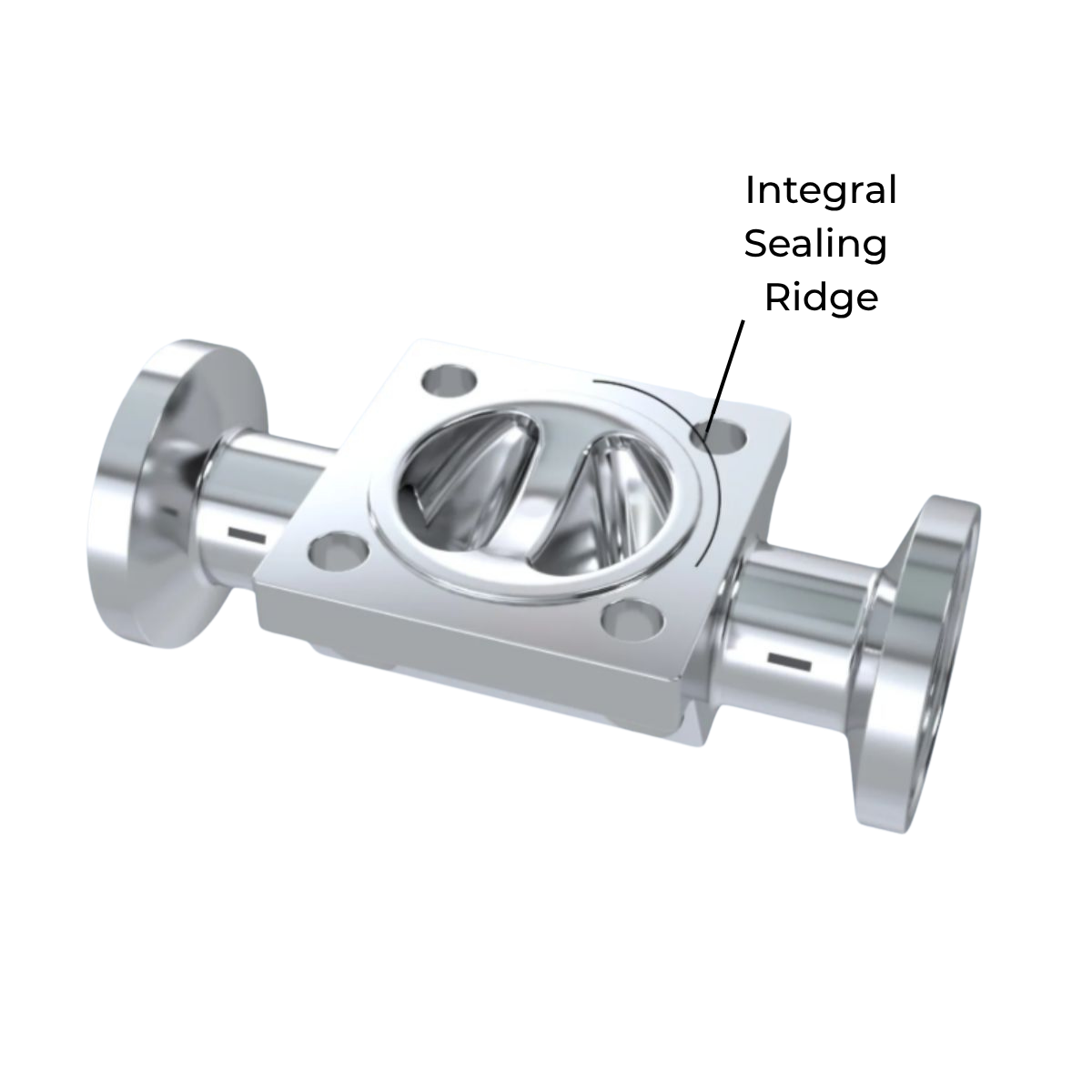
Integral sealing ridge machined into the body of an Aquasyn diaphragm valve

The sealing ridge is machined into the body, not molded onto the diaphragm, so process fluid is not trapped at the seal and the seal line is set by the machining.

Closed: diaphragm sealed on the weir
Section view of an Aquasyn biotech two-way diaphragm valve with a manual bonnet. Closed, the compressor presses the diaphragm onto the weir until the Tork-Tite feet stop it. Open, the diaphragm lifts and flow passes over the weir.Manual bonnetPosition indicatorCompressor shapedto the weirTork-Tite feet:metal-to-metal stopIntegral sealingridgeDiaphragm:PTFE face onEPDM backingWeir, machined into the bar-stock bodyInletOutlet1234567
  1. 1Manual bonnet
  2. 2Position indicator
  3. 3Compressor shaped to the weir
  4. 4Tork-Tite feet: metal-to-metal stop
  5. 5Integral sealing ridge
  6. 6Diaphragm: PTFE face on EPDM
  7. 7Weir in the bar-stock body

Section through a biotech two-way valve with a standard manual bonnet. Simplified, not to scale.

  1. 1

    Ridge and bore from one bar

    The sealing ridge is machined into the body in the same operation as the bore, so it cannot shift and there is no joint between ridge and body.

  2. 2

    Turn until it stops

    The compressor drives the diaphragm onto the weir until the Tork-Tite feet land metal to metal. A manual bonnet gets there in under one turn.

  3. 3

    The same seal every cycle

    The stop fixes the diaphragm position, so the seal and the flow are repeatable and do not depend on who closed the valve or how hard.

  4. 4

    Mount it at the drain angle

    Line up the drain marks etched on the end connections at the angle for the size, and the valve self-drains instead of holding a pool.

Sizes and drain angles

Biotech valve sizes and drain angles

The biotech series is Aquasyn's small-frame range: one common valve body for ¼, ⅜ and ½ in., with the same features as the full-size two-way valves. For ¾ in. up to 4 in., use the standard two-way diaphragm valves, and fractional and full-size valves can be combined in custom hybrid assemblies. Each size drains at its own angle, shown here in end view.

41°

¼ in. valve

Drain angle 41°

The steepest angle: in the smallest bore, surface tension holds the most liquid.

30°

⅜ in. valve

Drain angle 30°

Set by eye from the drain marks etched on the end connections.

25°

½ in. valve

Drain angle 25°

The largest of the three, on the same compact body.

A diaphragm valve only self-drains when it is installed at its drain angle. Drain marks are etched on every end connection, so the installer can set and check the angle by eye. Check the orientation before tack-welding: a valve welded in at the wrong angle holds a pool that cleaning cannot reach. If your layout changes after the valve is specified, send us the new arrangement so the drain angle can be confirmed before you order.

Spec builder

Build your biotech valve spec

Seven quick steps, all from the Aquasyn catalogue. Pick an option and the builder moves on. The drawing, the catalogue code and the spec update as you go, and one button carries the spec into your quote request.

Step 1 of 7Size

Which valve size do you need?

All three sizes share one compact small-frame body. For ¾ in. to 4 in., see our two-way diaphragm valves.

Which body material?

All bodies are machined from bar stock, never cast, and fully traceable.

Which surface finish?

Mechanical polish or electropolished, from 25 Ra down to 5 Ra.

Surface finish (Ra)
Electropolished

Which end connections?

Pick a type, then the connection for your size. Both ends are the same.

Connection at both ends

Which operator?

Tork-Tite feet are on every manual bonnet and actuator.

What will the valve see?

Tick everything, including the CIP wash. The next step rates each diaphragm against it.

Which diaphragm?

Rated against what you ticked. The best match is picked for you unless you choose another.

APreferredBWorkable within limitsCAvoid

Ratings come from Aquasyn's diaphragm compatibility matrix, and every diaphragm is molded in the open position. We review your real process fluid before we quote.

Your spec is ready

Check it, change anything with Edit, then add it to your quote request.
    Pick an option to move on

    Every option comes from the Aquasyn catalogue. Your spec drops into the quote form below, and nothing is sent until you submit the form.

    Your biotech valve
    ½ in. biotech diaphragm valve
    Aquasyn catalogue codeA 08 L 2 AC AC E 16• is confirmed on the quotation.

    Added to the quote form below.

    With the request, tell us the working pressure and temperature, how the valve sits in the line, the documents you need and how many valves.

    Drain angle25°for this size
    Pressure10 bar145 psi, manual valves at 21 °C
    Diaphragm−51 to 141 °CEPDM, continuous
    Specifications

    Biotech diaphragm valve specifications

    Standard options from the Aquasyn catalogue for biotech two-way diaphragm valves. Special end connections, configurations and materials can be quoted as a custom valve.

    Valve typeTwo-way weir diaphragm valve, straight through
    Sizes¼, ⅜ and ½ in. nominal on one common small-frame body (¾ to 4 in. in the standard two-way range)
    Body materials316L stainless steel, Hastelloy or AL-6XN, machined from bar stock (never cast) and fully traceable
    Material controlASME BPE compliant chemistry: sulfur 0.005 to 0.017%, ferrite below 0.5%. EN 10204 3.1 material test reports as standard
    Surface finish25 Ra down to 5 Ra, mechanical or electropolished
    End connectionsHygienic (sanitary) clamp, step-up clamp, orbital weld tube ends, hose barb or reducing hose barb. Butt weld and special connections available
    DiaphragmsEPDM, PTFE-faced (TFM 1700) EPDM, silicone or Viton, molded in the open position. USP Class VI, ASME BPE and FDA 21 CFR 177.2600
    Pressure rating10 bar (145 psi) at 21 °C (70 °F) for manually operated valves, derated by diaphragm at higher temperatures
    Temperature range−29 to 141 °C (−20 to 285 °F), depending on the diaphragm
    Flow coefficient½ in. valve: Cv 3.0 (US gal/min) fully open, ±10%
    BonnetStainless steel, fully autoclavable, with patented Tork-Tite feet and fixed internal travel stops. Manual bonnets close in under one turn
    Self-drain angle41° (¼ in.), 30° (⅜ in.), 25° (½ in.), with drain marks etched on the end connections
    ActuationManual (standard, O-ring sealed or Submersible bonnet), Pneumatic (NC or NO, spring return or double acting) or Electric (eMaxion)
    Pneumatic extrasLimit switches, banjo mount solenoid, NAMUR adaptor or positioner, as optional extras
    ManufactureMade in the USA by Aquasyn, with in-house machining, welding, polishing and electropolishing
    Applications

    Where biotech valves are used

    Wherever a bioprocess runs small lines that must clean, steam and drain like the big ones.

    Filtration skids

    Small lines and drains on filtration skids.

    Chromatography skids

    Compact valves where skid space is tight.

    Bioreactors

    Fractional lines around the vessel.

    Tight spaces

    A compact alternative to full-size valves where space is at a premium.

    Hybrid assemblies

    Custom valves and assemblies that combine fractional and full-size valves.

    Since 1996Aquasyn high-purity diaphragm valves
    Made in the USAMachined, welded and electropolished in house
    EN 10204 3.1Material test reports as standard
    USP Class VIAll four diaphragm compounds, plus FDA 21 CFR 177.2600
    FAQ

    Biotech diaphragm valve FAQ

    Answers to common questions about biotech diaphragm valves.

    What are biotech diaphragm valves?

    Biotech diaphragm valves, also known as biotech valves or biotechnology valves, are Aquasyn's small-frame two-way hygienic diaphragm valves in ¼, ⅜ and ½ in. They are a compact alternative to full-size valves on bioreactors, filtration and chromatography skids, and other systems where space is at a premium. A diaphragm closes onto a weir machined into the stainless body, so the mechanism never touches the product.

    What sizes do biotech diaphragm valves come in?

    ¼, ⅜ and ½ in. nominal, all on one common small-frame body. That is the whole biotech series: from ¾ in. up to 4 in., Aquasyn's standard two-way diaphragm valves take over, with the same features. Fractional valves can also be built into custom hybrid valves and assemblies with larger ones.

    Which end connections are available?

    Hygienic clamp (¼, ⅜ or ½ in.), step-up clamp (¼ or ⅜ to ½ in., ½ to 1 or 1½ in.), orbital weld tube ends (¼ and ⅜ in. OD with 0.049 in. wall, ½ in. OD with 0.065 in. wall), hose barb (¼, ⅜ or ½ in.) and reducing hose barb (⅜ to ¼, ½ to ⅜ or ½ to ¼ in.). Butt weld and special end connections are also available.

    How does a biotechnology diaphragm valve seal?

    The body, weir included, is machined from one piece of bar. To close the valve, the compressor pushes the diaphragm down onto the weir. Around the edge, the diaphragm is pressed against an integral sealing ridge machined into the body in the same operation as the bore, rather than relying on a bead on the diaphragm that can trap process fluid. The seal line is set by the machining.

    What do Tork-Tite feet do?

    Tork-Tite feet are patented machined stops on the corners of every Aquasyn bonnet and on the compressor, finished to match the weir profile. When the valve closes, the feet land metal to metal and fix the diaphragm position, so it sees the same compression every time. That gives zero-leakage closure and repeatable flow, stops over-tightening and lets a manual bonnet close in under one turn.

    Which diaphragm material should I choose?

    EPDM is the default for WFI, purified water, buffers, steam and caustic CIP. PTFE-faced (TFM 1700) EPDM has the broadest chemical resistance, silicone has the widest temperature range and Viton suits solvents, hydrocarbons and oils. Choose against the most aggressive thing the valve will see, which is often the CIP wash rather than the product. The spec builder on this page rates all four against what you tick, and we review your real fluid before we quote.

    Can biotech valves be cleaned and sterilised in place?

    Yes. There is no stem in the product stream and no crevice around a stem, so a CIP cycle reaches every wetted surface and the valve can be steamed in place. Pick the diaphragm for your CIP and SIP conditions: EPDM tolerates repeated steam and caustic best. Manual bonnets are fully autoclavable, and the submersible bonnet is fully drainable for wash-down protocols.

    Which operators fit a biotech diaphragm valve?

    A manual bonnet (standard, O-ring sealed or submersible), a pneumatic actuator (normally closed or normally open, spring return or double acting) or an eMaxion electric actuator. Pneumatic actuators can take limit switches, a banjo mount solenoid, a NAMUR adaptor or a positioner as optional extras. Manual and actuated bonnets all have Tork-Tite feet.

    What is the drain angle of a biotech valve?

    A diaphragm valve only drains when it is rotated to its drain angle: 41° for ¼ in., 30° for ⅜ in. and 25° for ½ in. Smaller bores need a steeper angle because surface tension holds more liquid. Drain marks are etched on the end connections so the angle can be set and checked by eye.

    What pressure and temperature are biotech diaphragm valves rated for?

    Manually operated valves are rated to 10 bar (145 psi) at 21 °C (70 °F), derated by diaphragm at higher temperatures. The temperature range is −29 to 141 °C (−20 to 285 °F), depending on the diaphragm compound.

    Which body materials and finishes are available?

    316L stainless steel as standard, with Hastelloy or AL-6XN. Bodies are machined from ASME BPE compliant bar stock, never cast, with controlled sulfur (0.005 to 0.017%) and ferrite below 0.5%, and are fully traceable. Finishes run from 25 Ra down to 5 Ra, mechanical or electropolished.

    What documentation comes with the valves?

    EN 10204 3.1 material test reports come as standard. Diaphragms conform to USP Class VI, ASME BPE and FDA 21 CFR 177.2600 and have passed the 177.2600 extractables test. Every diaphragm comes with a certificate of conformance and lot traceability.

    Do you also supply valves for single-use tubing lines?

    Yes. Where a line runs single-use tubing instead of stainless pipe, our single-use pinch valves close on the outside of the tubing, so nothing touches the product. They come in manual, pneumatic and motorized versions.

    How do I get a quote for biotech diaphragm valves?

    Use the form on this page. Tell us the size, end connections, body material, finish, diaphragm, actuation and quantity, or add your spec from the spec builder, which also gives the Aquasyn catalogue code. We come back to you with a quotation.

    Quotation for your valves

    Request a Biotech Diaphragm Valve Quote

    Tell us the size, ends and diaphragm, or add your spec from the builder. We reply with a quotation for your valves.

    • Quotation for your valves and quantity
    • ¼, ⅜ or ½ in. in 316L, Hastelloy or AL-6XN
    • Hygienic clamp, orbital weld or hose barb ends
    • Manual, Pneumatic or Electric actuation
    • Your spec and catalogue code carried into the request
    Thank you! Your submission has been received!
    Oops! Something went wrong while submitting the form.