
Pneumatic Pinch Valve for Single-Use Tubing
An air-operated pinch valve for fast, high-cycle on and off control. Skid air at 4 to 6 bar closes the tube from the outside, so nothing but your tubing touches the product.
A central pinch point inside an encapsulated 316L stainless steel pinch head gives the same uniform closure, cycle after cycle. Sizes fit silicone, TPE, braided and reinforced tubing from ¼ in. to 1 in. ID, and valves are supplied normally open or normally closed. Part of our single-use pinch valve range.
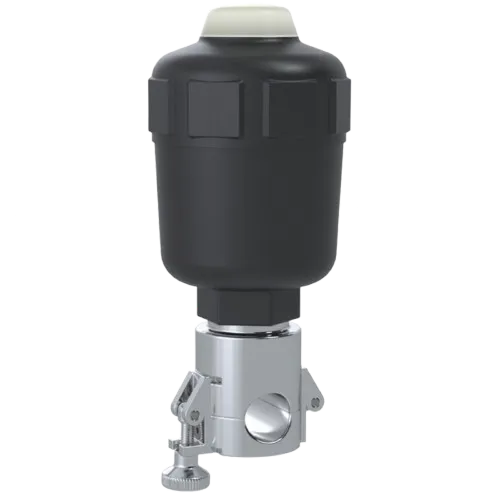
How Does a Pneumatic Pinch Valve Work?
Pneumatic pinch valve, defined
A pneumatic pinch valve is a pinch valve driven by compressed air. It squeezes flexible tubing from the outside to stop the flow. The tubing is the whole fluid path, so the valve never touches the product and only the tubing is replaced between batches.
Skid air at 4 to 6 bar drives a piston in the actuator. The piston pushes the stem and its rounded pinch bar down onto the tubing, pressing it against a fixed jaw inside the encapsulated 316L stainless steel pinch head until the tube walls meet and flow stops. Release the air and the tube opens again. Air actuation gives fast, uniform closure for high-cycle on and off duty, and the valve can be supplied normally open or normally closed.
- Visible indicator moves with the piston
- Air actuator skid air drives the piston
- Stem and pinch bar press the tube on the jaw
- 316L pinch head clamp-on, reused
- Single-use tubing the only wetted part
- 1
Connect skid air
Connect the skid's compressed air line to the actuator once, at 4 to 6 bar (58 to 87 psi). It stays connected between batches.
- 2
Clamp on the tubing
Lay the tubing in the pinch head and close the clamp-on body by hand. No tools and no fittings: the valve pinches directly on the tube.
- 3
Switch the air
Your control system switches the air and the pinch closes the tube at the central pinch point; release the air and it opens. A visible indicator shows the valve position.
- 4
Change the tubing, keep the valve
The 316L pinch head is reusable. Between batches only the single-use tubing is replaced, in seconds and without tools.
Size and Configure Your Pneumatic Pinch Valve
The pinch head is matched to the tubing it closes, and the valve to what your line should do if the air is lost. Tap a common tubing size, pick one from the list or type it in fractions, inches or mm, then answer three quick questions. The configurator shows the valve to order and what we still need to quote, and one click puts it all in your quote request.
Standard sizes fit tubing from ¼ in. (6.4 mm) to 1 in. (25.4 mm) ID. Other sizes can be configured.
- TubingSize to choose
- MaterialTo choose
- Fail-safeTo choose
- FeedbackTo choose
- Air supplySkid air, 4 to 6 bar (58 to 87 psi)
- QuantityTo add
Your valve builds as you answer
Each answer on the left updates the tubing, fail-safe position and feedback here, and tells you what we still need to quote.
Six answers and your request is ready to quote.
A guide only. We confirm the valve size, fail-safe position and air requirement with your quote.
Pneumatic Pinch Valve Specifications
Pneumatic, mechanical and material data for the ARTēVA pneumatic pinch valve, the air-operated version of our single-use pinch valve. Sizes are given in inches, the way tubing and valves are specified.
| Specification | Detail |
|---|---|
| Actuation | Pneumatic, on compressed skid air |
| Air supply | 4 to 6 bar (58 to 87 psi) |
| Fail-safe position | Normally open or normally closed, to suit your process |
| Closing | Fast, uniform closure for high-cycle on and off duty: around 100 ms on the ¼ in. size as a rough guide, depending on air pressure and tubing |
| Valve positions | Open or closed |
| Tubing sizes | ¼ in. (6.4 mm) to 1 in. (25.4 mm) ID; smaller tubing with overmolded ¼ in. sections where the valve clamps; other sizes configured to your specification |
| Tubing types | Silicone, TPE, braided and reinforced single-use tubing; no proprietary tubing |
| Pinch head | 316L stainless steel, corrosion resistant; single central pinch point in an encapsulated body; reusable |
| Connection | Clamp-on, pinches directly on the tube; tool-free installation and tubing change |
| Wetted parts | None: only the tubing touches the product |
| Position indication | Visible indicator as standard. Optional extra: a control head on the actuator that sends the open or closed position to your PLC |
| Process temperature | Set by the selected tubing material |
| Configurations | Tubing size, connection type and actuation to your specification |
| Certificates | Material of construction (MOC); others on request |
Where Pneumatic Pinch Valves Are Used
Pneumatic actuation fits lines that already run compressed air on the skid and switch often. The valve stays on the line; the single-use tubing changes with each batch.
- High-throughput production linesCommercial production lines with compressed air already on the skid, where valves open and close many times in every batch.
- Media and buffer transferRouting media and buffer from single-use bags to several points in the process, switched on command from the control system.
- Filtration and chromatographyFiltration and chromatography systems and harvest and collection paths, with single-use tubing that avoids cross-contamination between batches.
- Process diversion and samplingSampling points, bypass and diversion paths where quick, reliable switching is needed without contaminating the main product stream.
- Valve blocks with overmolded linersSeveral pinch points in one reusable block, closing on an overmolded single-use liner that is the only part replaced between runs.
- Complete single-use fluid pathsSpecified with our fluid path assemblies and PIXER single-use pumps from one supplier.
Pneumatic, Electric or Manual Pinch Valve?
All three ARTēVA pinch valves close the same single-use tubing, from ¼ in. to 1 in. ID, with the same reusable 316L stainless steel pinch head. Only the actuation changes, so choose by how the valve will be controlled.
| Pneumatic | Motorized (Electric) | Manual | |
|---|---|---|---|
| Actuation | Skid air on an air actuator | 24 V DC bipolar stepper motor | By hand |
| Valve positions | Open or closed | Open, closed or held part open, set in 704 steps | Open or closed, with hand-tightening adjustment |
| Fail-safe | Supplied normally open or normally closed | Holds its last position on power loss | No air or power to lose |
| Position feedback | Visible indicator; control head for a PLC signal as an optional extra | Visible indicator; encoder on the M12 8-pin version | Visible open and closed indication |
| Utilities | Skid air, 4 to 6 bar | 24 V DC | None |
| Best for | High-throughput production lines with compressed air already on the skid | Automated skids, perfusion, filtration control, media and buffer transfer | Lab-scale development, benchtop set-ups and mobile carts |
Pneumatic Pinch Valve FAQ
What is a pneumatic pinch valve?
A pneumatic pinch valve is a pinch valve driven by compressed air. It squeezes flexible tubing from the outside to stop the flow, so the tubing is the only part that touches the product and only the tubing is replaced between batches.
How does a pneumatic pinch valve work?
Skid air drives a piston in the actuator. The piston pushes the stem and pinch bar down onto the tubing and presses it against a fixed jaw inside the encapsulated 316L stainless steel pinch head until the tube walls meet and flow stops. Release the air and the tube opens again.
Is an air-operated pinch valve the same as a pneumatic pinch valve?
Yes. Air-operated, air-actuated and pneumatically actuated pinch valves are all pneumatic pinch valves: the pinch is driven by compressed air rather than a motor or a handwheel.
What air pressure does a pneumatic pinch valve need?
Skid air at 4 to 6 bar (58 to 87 psi). The pressure needed also depends on the tubing type and valve size, so we confirm it with your quote. Connecting the air is a one-time step: the line stays connected between batches.
Normally open or normally closed: which pneumatic pinch valve do I need?
A normally open valve stays open with the air off, and skid air closes it. A normally closed valve stays closed with the air off, and skid air opens it. Choose by what the line should do if the air is lost; we supply either version. Tell us which you need, or ask us to advise, when you request a quote.
How fast does a pneumatic pinch valve close?
It gives fast, uniform closure, which suits high-cycle on and off switching. As a rough guide, the ¼ in. size goes from open to closed in around 100 ms; the exact time depends on your air pressure and tubing.
Can a pneumatic pinch valve throttle flow?
No. A pneumatic pinch valve is used fully open or fully closed. To hold a part-open position, our motorized pinch valve can be commanded to any of 704 steps, and for fine proportional control a single-use diaphragm valve is the closer fit.
What size pneumatic pinch valve do I need?
The valve is sized by the tubing it closes. Standard sizes fit ¼ in. (6.4 mm) to 1 in. (25.4 mm) ID, and the pinch head is matched to your tubing ID and OD. Enter both in the configurator above or in the quote form.
What tubing does the pneumatic pinch valve fit?
Silicone, TPE, braided and reinforced single-use tubing from ¼ in. (6.4 mm) to 1 in. (25.4 mm) ID, with no proprietary tubing. For smaller tubing we can overmold ¼ in. sections onto the line where the valve clamps it. Tell us your tubing ID, OD and material and we will match the valve size.
Does any part of the valve touch the product?
No. The valve pinches the tube from the outside, so the tubing is the only wetted part. There is no valve body to clean or validate, and the 316L pinch head is reused.
How is the tubing changed?
By hand, in seconds and without tools. Open the clamp-on pinch head, lift out the used tubing, lay in the new tubing and close the head with the thumb nut.
Can I get valve position feedback to my PLC?
Yes, as an optional extra. Every valve has a visible position indicator as standard. For a signal to your PLC, add a control head: a unit on top of the actuator that senses the valve position and sends an open or closed signal.
What is the difference between a pneumatic and an electric pinch valve?
A pneumatic pinch valve runs on skid air and is used open or closed, which suits fast, high-cycle switching. An electric pinch valve, our motorized pinch valve, runs on 24 V DC with no compressed air and can be commanded to any of 704 steps between open and closed. Manual pinch valves need no utilities.
Can several pinch valves work together as a manifold?
Yes. We supply valve blocks where several pinch points close on an overmolded single-use liner. The block is reused and only the liner is replaced between runs.
What is the process temperature range?
It is set by the tubing material you select rather than by the valve. Tell us your tubing and we will confirm the working range.
What documentation comes with the valve?
Material of construction (MOC) certification is available, and other certificates are available on request. Tell us what your project needs when you request a quote.
Is a pneumatic pinch valve the same as a diaphragm valve?
No. A pneumatic pinch valve closes the tubing from the outside and has no wetted parts. A single-use diaphragm valve has a disposable wetted body and diaphragm and gives finer proportional control.
Request a Pneumatic Pinch Valve Quote or Datasheet
Tell us your tubing ID, OD and material, whether the valve should be normally open or normally closed, whether you need a position signal and how many you need. We will send the datasheet for the right size and, if you ask, a quotation.
- Valve size matched to your tubing ID and OD
- Normally open or normally closed to suit your fail-safe
- Datasheet and general arrangement drawing
- 316L body; MOC and other certificates on request