
Why Bioprocessing Pumps Behave Differently at Scale
In process development and MSAT, it’s common to hear that a pump choice is "safe" because it worked perfectly at small scale. Flow rate was stable, pressure alarms never triggered, and no obvious issues appeared during development runs. Yet during scale-up or tech transfer, variability emerges - sometimes subtly, sometimes catastrophically - even though the reported flow rate has not changed.
This is not bad luck, and it is rarely operator error. In many cases, it is a direct consequence of how pump behaviour changes with scale.
The key issue is that flow rate is an average, while the process experiences instantaneous pressure and velocity. As scale increases, small differences in how a pump generates flow are amplified. What looked stable in PD can behave very differently once volumes, run times, and downstream sensitivity increase.
Why scale exposes pump behaviour
Many single-use pump families achieve higher throughput by increasing motor speed, stroke frequency, or internal actuation intensity. On paper, the pump looks identical at larger sizes: same product family, same operating principle, higher flow rating. In practice, the internal dynamics can change significantly.
As motor speed increases, pressure oscillations become sharper and more frequent. These oscillations are often invisible when only average flow is monitored, but they directly affect filters, membranes, cells, and any pressure-sensitive step in the process. At small scale, the system can tolerate this behaviour. At manufacturing scale, it often cannot.
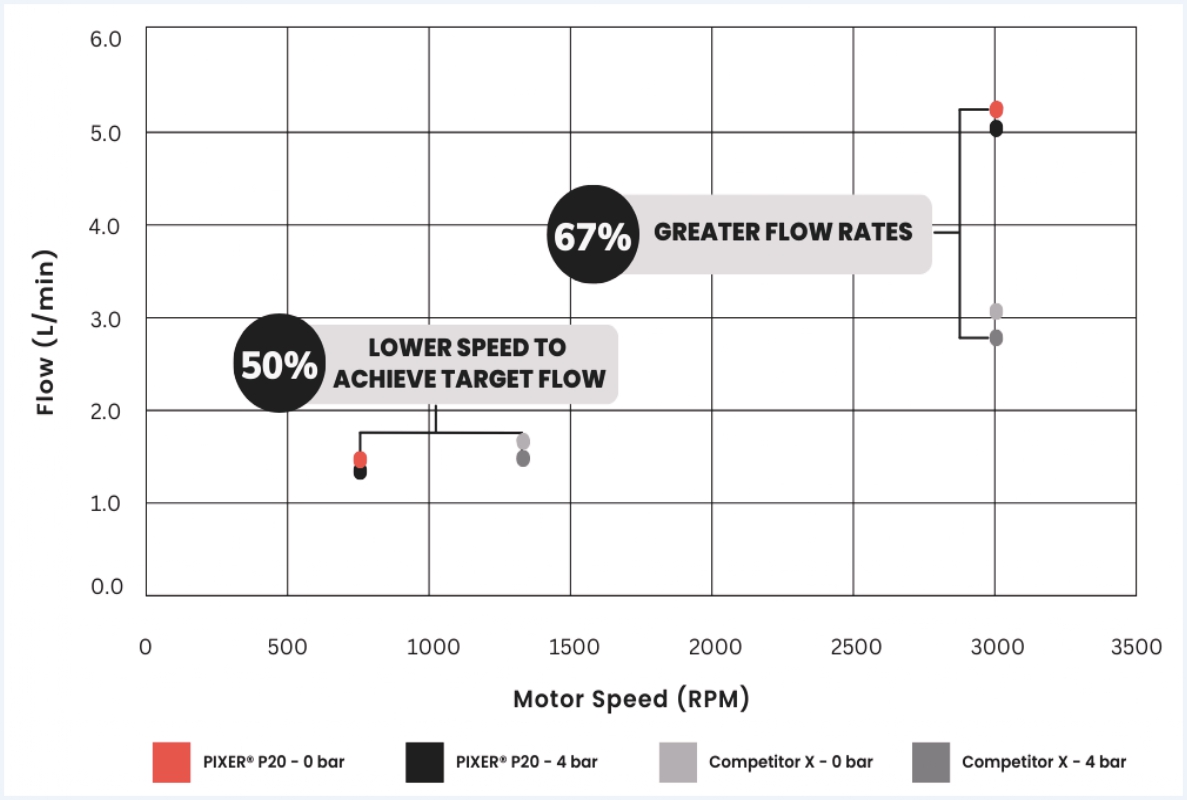
The graph illustrates this clearly. For a given target flow rate, a multi-diaphragm pump can achieve that flow at substantially lower motor speed compared to a lower-diaphragm alternative. Lower speed is not just an efficiency benefit — it is a mechanical stability benefit. Running slower reduces the magnitude and frequency of pressure fluctuations, which becomes increasingly important as scale increases.
The important takeaway for MSAT teams is that scale does not create instability; it reveals it. If a pump needs to work harder to deliver flow, the consequences tend to appear later, not earlier.
Architecture changes are the hidden risk in scale-up
A less obvious but equally important factor is pump architecture consistency across sizes. In some pump families, scaling up involves changes in diaphragm count, internal timing, or flow path geometry. These changes are rarely obvious from datasheets alone, yet they fundamentally alter how flow is generated.
From a process perspective, this means the pump used at manufacturing scale is not simply a larger version of the one used in development — it is a different machine with different dynamic behaviour. The process may still meet nominal flow targets, but it is no longer experiencing the same pressure profile.
This is one reason MSAT teams often encounter variability during late-stage scale-up even when recipes, materials, and setpoints remain unchanged. The assumption that “same flow rate equals same behaviour” quietly breaks down.
Why pressure stability matters more at scale
Pressure deviation data highlights this effect. When comparing pumps with different diaphragm architectures, the difference is not in peak flow capability but in pressure stability over time.
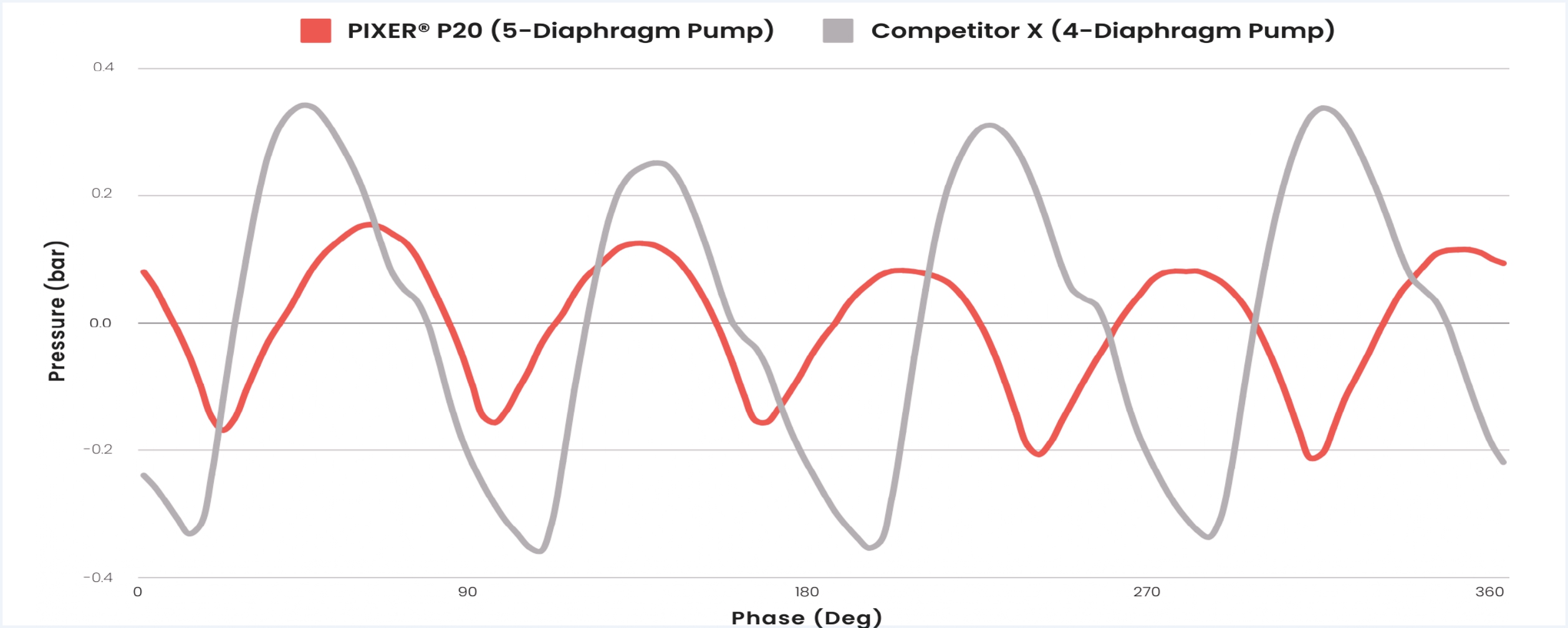
The data shows that higher-diaphragm architectures produce smoother pressure waveforms with lower standard deviation. Instead of large pressure peaks and troughs, the system experiences smaller, more frequent pressure steps. This reduces mechanical stress on the process and leads to more repeatable behaviour run to run.
At small scale, these differences may be masked by system compliance and short run durations. At larger scale — where runs are longer, volumes are higher, and downstream components are more sensitive — the same differences become process-relevant.
All PIXER models are rated to a maximum operating pressure of 6 bar (87 psi), though in practice the usable ceiling is set by the most pressure-limited component in the flow path rather than by the pump.
Maintaining architecture continuity through scale-up
One way to avoid this problem is to scale throughput without changing pump behaviour. This requires maintaining the same fundamental architecture across pump sizes, rather than relying on increased aggressiveness to achieve flow.
The PIXER single-use pump range is designed around this principle. From smaller development-scale units to higher-throughput manufacturing models, the underlying diaphragm architecture remains consistent. Scale is achieved through size and capacity, not through changes in how flow is generated.
| Model | Flow range | Displacement | RPM range | Internal volume |
|---|---|---|---|---|
| P0 | 0.73 mL/min – 1.10 L/min | 0.73 mL/rev | 1–1,500 | 22 mL |
| P10 | 1.7 mL/min – 5.10 L/min | 1.7 mL/rev | 1–3,000 | 45 mL |
| P20 | 16.7 mL/min – 40.1 L/min | 16.7 mL/rev | 1–2,400 | 300 mL |
| P30 | 135 mL/min – 175.5 L/min | 135 mL/rev | 1–1,300 | 1,300 mL |
| P40 | 185 mL/min – 240.5 L/min | 185 mL/rev | 1–1,300 | 2,150 mL |
For MSAT teams, this architectural continuity matters. It means that pressure profiles, pulsation behaviour, and flow dynamics remain comparable across scales, reducing the risk of late-stage surprises during tech transfer or scale-up.
A practical lens for MSAT teams
When evaluating single-use pumps for scale-up, flow rate alone is not enough. Useful questions to ask include how the pump achieves higher flow at larger sizes, whether motor speed increases significantly for the same flow, whether the internal architecture remains consistent across the product range, and what pressure stability data is available beyond average flow numbers.
Choosing a feed pump for a filtration step in particular is covered in more depth in our guide to TFF feed pump selection: peristaltic vs diaphragm pumps.
Pumps rarely fail loudly during scale-up. More often, they drift quietly into becoming the largest uncontrolled variable in the process. Understanding how pump behaviour changes with scale — and whether it changes at all — is one of the most effective ways MSAT teams can reduce risk before it appears.